Purpose
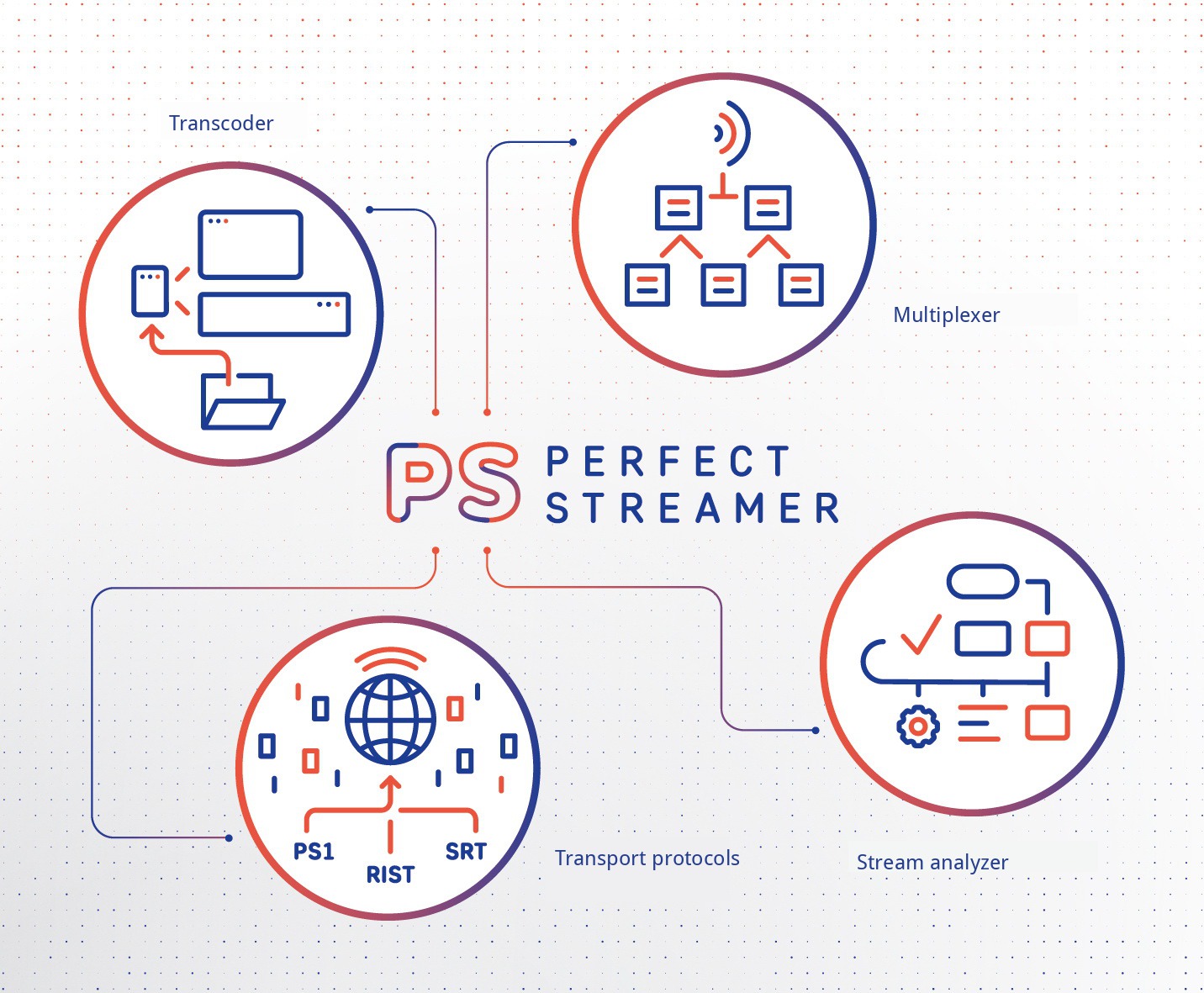
The Perfect Streamer program is designed to transmit MPEG-TS streams over the public Internet with packet loss and delays. It uses Perfect Stream (PS1), an in-house UDP-based protocol. The standard Pro-MPEG / RTP+FEC (also known as SMPTE 2022-1/2) and SRT protocols are also supported, which allows organizing channels both between Perfect Streamer instances and with other programs or equipment that support these protocols.
PS1 transport protocol works on the principle of Automatic Repeat reQuest (ARQ). It has low resource consumption and allows to transmit high bitrate streams.
Pro-MPEG / RTP+FEC (Pro-MPEG COP3, also known as SMPTE 2022-1/2) — RTP with forward error correction (FEC). Described in the IEEE standard (https://ieeexplore.ieee.org/document/6738329) and supported by a range of equipment. Advantage — low latency. Disadvantage — high additional traffic, and it works poorly with large packet losses.
SRT is an open protocol developed by Haivision. It is based on the UDT protocol. It is widely adopted and has good packet-loss compensation characteristics.
RIST is an open protocol. It is based on RTP/RTCP. It works on the Automatic Repeat reQuest (ARQ) principle without ACK, only NACK, which provides high efficiency.
Standard transport protocols such as HLS, HLS SSL, MPEG-DASH, UDP, RTP, RTSP, HTTP, etc. are supported.
A transcoder is available with support for Nvidia Encoder, Intel VPL (Intel Media SDK/Intel QSV) and Software CPU.
The program features stream redundancy, an EPG server, a multiplexer and demultiplexer, an EIT generator, work with DVB cards, a professional analyzer (TR 101 290 and more advanced), graphs, AES encryption, mosaic, modification of metadata in MPEG-TS, and more.
Integration with Zabbix, Grafana and other monitoring systems is supported.
